Masternode and ZenCash SecureNode SuperNode Setup Service (Outdated)
Outdated Article
I no longer consider Masternodes to be a good investment. Most of them are scams or the return is just too small. So unless you want the governance involved with a masternode project, I’d stay away from them altogether. I no longer host any masternodes except for Horizen Supernodes and Securenodes for a very select clientele. For the most part, if you want to host a masternode, you should use an automated service like Allnodes. The information on this page is kept just as legacy information.
The average person looking for returns is FAR better off using Defi or simply staking their coins than using masternodes. I am currently working on a Defi introduction and tutorial and will update this page once that is done.
Masternodes 2018-2020…Legacy information (Outdated)
0
Masternodes are incredibly popular right now. There has been an explosion in the number of masternode projects, and a kind of nuclear arms race to attract new buyers with high ROI. Many of the new coins start out with 1000% ROI or higher. This means that you could get your initial investment back within 2 months (if the price holds).
But setting up a masternode often requires a bit of Linux know how. The most popular set up is called a “cold wallet” where the coins that are kept as collateral live in your desktop wallet (preferably encrypted). Then a Linux Virtual Private Server (VPS) is set up that connects to the collateral and provide 24/7 masternode status regardless of whether your local wallet is open or connected to the internet.
Most of the masternode coins provide instructions on how to set up your Linux VPS. If you’re reasonably good at following directions, AND the guide is set up well, then it’s not too hard to figure it out yourself. However, many of the newer coins have incredibly bad guides.
They skip steps.
There are spaces where there shouldn’t be, and no spaces where there should be.
Commands that belong on one line are split, and commands that should be two separate commands are joined together.
Sometimes commands are missing altogether.
Some of the projects have nifty install scripts, so all you have to do is download an install file and run it. Qbic is an example of this, however, the script doesn’t fully work, and will leave you with a broken installation.
That’s where I come in. I’ve installed more than 30 masternodes from more than a dozen different coins. My first client had been trying to set up his Goa masternode unsuccsesfully for 6 days. He was losing $225 a day!!!
Here are the services I provide:
In addition to setting up the Masternode VPS, I also walk you through the process of setting up your local wallet and troubleshooting any issues that come up.
All prices are quoted in USD and payable in LTC, ETH, or BTC at the current market rate.
Masternode (setup only)
You supply the VPS
Cost is $75 per coin
Discount of $25 per coin if ordering multiple at the same time.
One week of troubleshooting is included.
I will show you how to maintain the VPS and update the server.
Masternode hosting (setup and 1 year of hosting)
Setup costs are the same as above (same as above)
One year of VPS hosting and server updates is $140
Note, if you host multiple coins with me, you may be able to host 3-4 coins on the same VPS. The fee to host an additional coin on the same VPS is $60.
Subscriptions are renewable
Discount example 1: Masternode hosting for 2 coins on the same VPS
Setup costs $50 x 2 = 100
Hosting cost $140 + $60 = 200
Discount example 2: Masternode hosting for 3 coins on the same VPS
Setup costs $50 x 3 = 150
Hosting cost $140 + $60 + 60 = 260
HoriZen (formerly ZenCash) Super/Secure Nodes
Horizen (formerly ZenCash) is my favorite masternode type project. It is an incentive-driven application platform with optional zk-SNARK based privacy features that aims to provide everyone with complete control of their digital footprint. Launched in May 2017 (no ICO and no pre-mine), the platform is said to enable real-life use cases beyond the ZEN currency, including the ability to privately chat with others, publish information and go anywhere on the web with complete privacy.
As of Fall 2019, the team is reportedly working towards releasing the Horizen SDK which would allow developers and enterprises to build what they call “an unbounded set of applications, products and services on top of the Horizen technology platform which is a truly decentralized side-chain based system powered by Horizen’s globally distributed multi-tier node network.”
Horizen Secureand Supernodes Nodes are quite a bit more involved than Masternodes both in set up and VPS requirements.
If you supply the VPS
Cost is $100 per Secure Node
One week of troubleshooting is included.
I will show you how to maintain the VPS and update the server.
HoriZen Secure Node hosting (setup and 1 year of hosting)
SuperNode: One year of VPS hosting and server updates is $232
SecureNode: Due to automation and economies of scale, I can offer Secure Node hosting including set up and maintenance for $60 per node. (Yes I know this is less than set up only. It’s a shook up crazy world.
Super/Secure Nodes cannot share a VPS with another coin.
Subscriptions are renewable
Frequently asked questions
What servers do you use?
I generally use OVH.com servers. Their VPS SSD 1 for masternodes and VPS SSD2 for secure nodes. I use Contabo for Super Nodes.
Will my coins be safe?
The coins will always remain in your local wallet. HOWEVER, I recommend that
As soon as you receive the coins that you make a back up of your wallet.
Store the back up in a safe place (from theft, fire, and water)
Encrypt your wallet and DON’T lose the password.
It’s far more likely that you lose your coins due to negligence or your computer crashing than to being hacked. Please, for the love of God, back up your wallet and don’t lose the password.
How long have you been doing this?
I set up my first mastenode coin for myself and on December 28, 2017 and set up my first client a few days later. I have been using Linux since 2003. I have been running Linux VPSes since 2011.
What happens if you decide to quit this business?
If I decide to stop providing this service,
All hosted clients will receive their full year’s subscription.
OVH allows transfer of a VPS to another account. A month before the expiration, I will help migrate all client VPS to their own accounts.
How do we get started?
If you haven’t filled out the sign up form yet, that’s a great place to start Once we’ve talked/chatted and both agree to the work to be done, then I’ll need
Your payment and the txID (so I credit the right person)
Your masternodeprivkey (In your local wallet, go to Debug Console and type “masternode genkey”
If you’re providing the VPS, I’ll need the IP address and root password.
What's involved on my (the client's) end?
You’ll need to
Buy the coins
Transfer them to your local wallet.
Create a new address and send the EXACT amount of collateral to the wallet.
Wait for at least one confirmation
Go to the Debug console in the wallet.
Type “masternode genkey”
Type “masternode outputs”
Copy all of the codes generated and save them in a text file.
I will walk you though what to do with them.
What's the difference between a Zencash Securenode and a Masternode?
Masternodes mostly speed up network transactions and sometimes vote on the direction of the project. Secure nodes receive daily challenges where they receive and send a shielded (private) transaction each day. This provides the network with thousands of private transactions making it much harder to track. A secure node needs needs more memory than the typical masternode needs in order to run the challenges. There is also a performance aspect to secure nodes and super nodes, in that the node must complete the challenge under a time limit.
Secure nodes and Super Nodes are also paid differently than a masternode. Masternodes are paid (usually) from a lottery system based on a list of all masternodes running at a given time. Once a masternode has received its rewards, it goes to the bottom of the list. Horizen nodes are based on daily uptime. A nodes that is up for ~93% of the day is paid for that day. Payments are manually reviewed and paid out once a week.
Telegram and Discord are probably the best ways to get in touch with me. My username on Telegram is @patrokov. I have a Discord Server for the Masternode Service. My username is patrokov#7056. If you can’t start a DM with me in Discord, it’s most likely because we are not on the same servers. I can also Skype (same username) but Skype doesn’t alert me when I get a message, so it’s better to use a different method unless we pre-arrange a meeting or chat. E-mail also works. You can fill out the form below, and I will get in touch with you.
When do you do this work?
I mostly do the work in the evenings after work and on weekends.
Congratulations gentle reader. You have just taken the most important step of your life. You’ve admitted that you’re a pathetic weakling and want to get stronger. Admitting you have a problem is the first step to recovery.
But now you have another problem. You’re overwhelmed with information, most of it contradictory. What should you do? Who should you trust? How do you even learn to speak the language?
What’s your goal?
Ultimately, the kind of training you do should be somewhat determined by your goal. And yet, strength is a generalized adaptation, so on the other hand, when you’re first starting out your strength program is going to be fairly general. Wrap your head around that for a moment.
That didn’t make any sense. Can you try again?
Okay. building a general base of strength will help in just about any endeavor that you do, whether it’s looking better, competing in strength sports, staying out of a nursing home (muscle loss is the number one cause of disability among the elderly), or performing better at a sport.
Use Compound Movements
Generally speaking, strength is going to be built best with compound movements. These are movements that involve more than one joint. Working multiple joints at the same time provides a number of benefits.
It takes less time. Now there are some people who simply love the gym and want to spend all day there. I’m going to assume that you actually have other things to do in your life and would like to minimize your time in the gym. Compound movements help you do this. because one movement will cover several different muscles and joints.
It works the body as a system by allowing muscles to function as they naturally want to.
It allows more muscle to be worked
Keep it simple stupid
As a novice you need a novice program. I mean, you can use an intermediate or advanced program, but you’re not going to get as much out of it. If you’ve ever driven a stick shift, you can start in 3rd gear, but it’s a lot easier and faster to start in 1st gear. So what makes a novice program?
Full body.
Increase the weight each workout
3-4 workouts per week. No more.
As a novice, you can recover from stress of lifting weights within about 2 days, so you want work out about that often, but not more. You don’t get strong by lifting heavy weights. You get strong by recovering from lifting heavy weights.
As a novice, you can increase the weight on the bar every workout, so a novice program should take advantage of this by designing it in. It’s not complicated. Choose a weight. Lift it for the prescribed number of sets and reps. Next time, add 5 pounds and repeat. When you can’t go up 5 pounds, go up by 2.5 pounds.
It’s simple to be a novice. A novice program should be simple. Don’t complicate it.
So where should I start? How about Starting Strength?
Note:I no longer endorse the Starting Strength method. It’s fine as far as it goes, but I think the approach is a bit too dogmatic. Its founder likes to stress that in his opinion, it’s the most effective and efficient way to get strong (which is debatable). But fast and efficient is nearly as important as enjoying yourself. Don’t get me wrong. You can do much worse than Starting Strength. So if you don’t know what else to do, follow the advice in this article. While you’re doing that investigate some other workout plans.
I like the Starting Strength model and recommend it. But you need to understand it. It’s a novice program, and will only last you 6 weeks to 6 months. It’s not meant to be done forever. It’s designed to be simple and provide a foundation of strength.
At its most basic, it starts out with four lifts on a two day split routine that looks like this:
Week: Monday Wednesday Friday
1: 1 2 1
2: 2 1 2
Phase 1: 2-4 weeks
Workout 1:
Squat 3×5
Overhead Press 3×5
Deadlift 1×5
Workout 2:
Squat 3×5
Bench Press 3×5
Deadlift 1×5
Optional:
You can add in chinups at the end of workout 2 if you like.
You can also add some barbell or dumbbell curls if you really want to.
So what weight should I start at?
Start with a lightweight. Probably just the bar. Do a set of five.
If it’s easy, add 10 pounds, and do another set of five.
Repeat step 2 until a set feels mildly challenging. (This might be step 1 for some people.)
The weight that felt challenging will be your starting weight. Do two more sets with that same weight.
Log the weight in a notebook. Next workout, you’ll add 5-10 pounds.
Phase 2: Once you’re comfortable with Deadlifts
Now, you add in power cleans in place of deadlifts on Workout 1.
Workout 1:
Squat 3×5
Overhead Press 3×5
Power Clean 5×3
Workout 2:
Squat 3×5
Bench Press 3×5
Deadlift 1×5
Phase 3: When it gets hard to recover from deadlifts
It’ll take you several months to get to this point, so I’m not going to describe it. By this time, hopefully you’ve bought the Starting Strength book, maybe joined their forum, and read enough on their website to know what to do.
How do I do these exercises?
I’m going to provide several videos for each lift below. You don’t have to watch them all. Generally speaking, watch the first one. Try it yourself. Take a video of yourself and compare your form to it. If you want or need more detail, then watch the others.
Squats
These are the foundation of the program, and the most functional of all the movements. More than any other lift, this one will keep you out of a nursing home.
Starting Strength recommends and prefers what are commonly referred to as “low bar” squats. The videos below teach their method. You don’t have to use low bar if you don’t want to. High bar squats will work just fine.
For years Alan Thrall preached “whatever works for you squats,” but when he plateaued and started using the Starting Strength style squats, he started progressing again. Here he teaches what he learned.
Here, Alan Thrall’s Coach describes three common mistakes.
Here we have Starting Strength Founder, Mark Rippetoe teaching his squat method. This is a playlist.
Overhead Press, AKA The Press
Playlist of Mark Rippetoe teaching the Overhead Press
Alan Thrall explaining how to set up for the Press
Deadlift
Alan Thrall teaching the 5 steps to a good deadlift. Similar to his squat, Alan had stopped progressing until he changed his technique.
Common Deadlift Errors:
And Mark Rippetoe teaching the Deadlift.
We’re half way THERE!!!
Okay, at this point you should be done with your first workout. If you wait three minutes between sets and take one minute for each set, it should have taken you about half an hour. So now enjoy a little Bon Jovi before you learn the next lift for Workout 2.
Benchpress
That’s a lot of videos! Anything else I should know?
How about diet?
Good question. Generally speaking you should be eating a fairly high protein diet. A good rule of thumb is 0.8-1 gram of protein per pound of bodyweight. If you’re very obese, you could go a bit lower. If you’re very thin, you might want to go a little higher.
You’re going to get the most out of Starting Strength if you’re in a caloric surplus. Building muscle is an anabolic process. Losing fat is a catabolic process. Your body doesn’t like to do both at the same time. (You can for a limited time if you’re starting out obese.)
When talking to skinny young men, the founder Mark Rippetoe’s advice is to eat 4500-5000 calories a day for the first month or two and don’t worry about getting fat. Once you’re strong, it will be easy to lose the extra weight. Personally, I prefer a much more moderate approach, with a small caloric surplus of about 250 – 350 calories per day. (You can estimate your maintenance as 15 x your bodweight in pounds. If you’re inactive, then use 14 x bodyweight.)
If you’re obese, then you’ll want to eat in a mild deficit at first, so maybe 12 x your bodyweight. If you’re very obese you could be more aggressive and eat 10 x bodyweight.
No matter which strategy you choose, understand that adequate nutrition plays a huge part in getting stronger, and reducing calories is going to reduce your strength. While you’re in the novice phase, don’t be too strict. Once you’ve gotten strong, then you can can reduce calories and get lean.
What about fat and carbs. You can go however you like here, however, higher in carbs, and moderate in fat tends to do better for most non-obese people.
What should I eat? The vast majority of your food should come from “whole” sources. If you don’t know what that means, then try Dr Jordan Feigenbaum’s advice and only eat foods that have one ingredient. I have a number of recipes on my website of foods that have helped me on my own fitness journey.
You should have some desserts or other treats that you enjoy every day. If you don’t, then you’re more likely to binge and go off diet altogether. My three secrets to not going overboard with treats are:
Log it before you eat it.
Weigh out your serving
Put the container away.
Leave the kitchen before you eat it.
This will make you less likely to have “just a little more” or go back for seconds and thirds, and fourths.
For further reading, here’s a nice long article on nutrition by Dr. Jordan Feigenbaum.
Is this going to make me big? I don’t want to be big.
Only if you eat in a large surplus. Now, the plan is to gain both muscle and fat during the initial novice phase, and then to lose the fat afterward. You’ll look a bit fluffy during this process, but it’s temporary.
If you’re worried about looking like this, that takes drugs. There is simply no way you’ll end up looking like this by accident!
Now, if you’re a woman, there are some extra things to be aware of.
As part of the adaptation process, your muscles are going to be a bit fuller temporarily. Stick with it, it will go away.
Your weight will fluctuate over the course of your menstrual cycle. You simply cannot compare your weight or your measurements from week to week. What you need to do is compare them to the same week the cycle before.
If you do win some chance genetic lottery and get bigger and stronger than expected, contact Jordan Feigenbaum so you can do great things in strength sports!
This is so exciting. Are there any fitness channels that you like?
This is a tough one. Most of the Youtube fitness channels are junk. Here are are few that I like that won’t lead you too far astray:
Starting Strength: Heck this whole article is about Starting Strength, so I guess I should recommend the Youtube channel. Mark Rippetoe (“Rip”) is quite the character. He’s certainly not everyone’s cup of tea. The channel has a bit of everything.
Barbell Medicine. Two Starting Strength who are also doctors run the website BarbellMedicine.com and have a podcast by the same name. Dr Feigenbaum’s youtube channel is their outlet. They are also active on Instagram. I really enjoy their take on things, although their programs are sometimes seemingly overly complicated.
Paul Revelia. Paul’s focus is body building, and he has an excellent reputation in prepping men and women for contests as well as just regular people who want to be fit. His main business is personalized coaching, but his youtube channel has tons of free helpful content, and he’ll send you a beginner’s workout and nutrition guide if you subscribe to his e-mail letter. He also has a number of female coaches on staff.
Lacey Dunn: Registered dietician and body builder, Lacey specializes in helping women achieve weight loss and their desired physique.
Alan Thrall: You’ve seen some of his videos above. Alan has a gym called Untamed Strength and recently became a Barbell Medicine coach. He now offers online coaching through Barbell Medicine.
Omar Isuf is a Canadian who just got into lifting. He’s quite the character, and his channel reflects his growth over the years that he’s been lifting. He likes to have lots of guests from the lifting world.
Should I get a personal trainer?
For the most part, no. Most of the personal trainers, especially the ones that work at commercial gyms (Planet Fitness, LA Fitness, 24 hour Fitness, etc.) are garbage. You’re lucky if their advice doesn’t actually harm you. It might be a good idea to get a coach, preferably someone who is familiar with and performs the basic compound lifts themselves. If you can’t find anyone local, you can get online coaching at both Starting Strength and Barbell Medicine.
I should also mention Stefani Glise: PBA’s own 2018 Outstanding graduate from the Business School is a personal trainer. I’ve known Stefani for several years. She’s the real deal.
And finally, if all else fails, you can post your questions and even videos of your form on the Starting Strength or Barbell Medicine forums and get answers for free.
The lifts are not all that terribly difficult, and you’re going to start with fairly light weights and slowly increase the weight over time, so don’t freak out. You’ve got plenty of time to fix your form and get better at it. If something is worth doing, it’s worth doing wrong. Because who’s naturally good at everything the first time?
Congratulations. You’ve decided to start lifting weights. But you’re not sure where to start, so you start searching the internet and youtube for guidance, and suddenly, you’re overwhelmed with terms that don’t seem to make any sense. You go to a gym and try to join in a conversation but people look at you weird because you’re using the words incorrectly.
This article should help clear up some of the confusion and help prevent some embarrassing moments while you transition from novice to expert.
Weightlifting, Weight Training, Lifting Weights, and more
Weightlifting technically always refers to Olympic Weightlifting. This is an officially recognized Olympic sport. It is very very specific. The two main components are the Snatch and Clean and Jerk. (Described later under Specific Exercises.) To avoid confusion, don’t say you’re weightlifting unless you’re doing olympic lifts. Sometimes abbreviated “oly” or “oly lifting”
Lifting weights on the other hand means any activity in which weights are being used.
Weight training is sometimes used interchangeably with lifting weights, although the term implies using the weights as part of a systematic plan to achieve a particular goal.
Powerlifting is a sport in which people compete in three different lifts. They do a single squat, bench press, and deadlift. You add the maximum weight for each lift together, and the highest total wins. It’s slightly more complicated, with weight classes, but that’s the general idea.
Strongman refers to a sport with a number very specific feats of strength including picking an Atlas stone (large round rock), giant tire flipping, and picking a log up off the ground and lifting it overhead. Strongman lifts are more awkward than Olympic lifts and Powerlifts.
Bodybuilding specifically refers to using weights for the purpose of winning bodybuilding competitions (or achieve a look that could). Bodybuilding is primarily concerned with size and shape of muscle. At the highest levels, bodybuilding depends on having the right genetics for symmetry and proportion. There are several different “levels” within bodybuilding. Traditional bodybuilding (think Arnold Schwarzenegger or Lou Ferrigno for us old people) is called Classic or Classic Physique. The newer class is “physique” where guys are typically smaller and wear board shorts instead of “posing shorts” (think Speedos).
Female bodybuilding has three levels, Physique (similar to men’s classic and is dominated by steroids), figure, and bikini. Bikini is the least muscled of the levels. There is also fitness which is kind of like figure but with some sort of athletic routine (usually gymnastic or dancing).
Aesthetics refers to training for looking good (which of course is subjective). The most popular male role model of aesthetics ever seems to be Brad Pitt’s character from Fight Club. Note that looking good with clothes on is not necessarily the same as looking good in clothes. Bigger typically looks better in clothes (for men anyway), while leaner typically looks better with no shirt.
Strength training refers to training to maximize strength. It could be for its own sake or for in the pursuit of a strength sport (Olympic Weightlifting, Strongman, Powerlifting, or other smaller specialty strength endeavors).
Training Terminology
Split refers to the number of workouts in a cycle, with most cycles taking a week. Each unique workout is usually assigned a letter (A,B,C, etc.) So a 3 day split generally refers to working out 3 days a week. For example Workout A on Monday, Workout B on Wednesday, and Workout C on Friday. A 2 day split has 2 workouts that alternate, you might do Workout A on Monday, Workout B on Wednesday, and then Workout A again on Friday. The next week, you would start with Workout B and repeat the pattern. A five day split has five different workouts. You get the idea.
Other Common Splits: Bro Split refers to a 5 or 6 day split, where each body part has its own workout. PPL (push/pull/legs) refers to a three day split where one day is “push,” another day “pull”, and a third day “legs”.
Rep (repetition) refers to one complete movement of an exercise. So in a squat, squatting down and standing back up is one complete rep.
A set is a number of repetitions done together. So 5 reps done in a row would be considered one set of 5 reps.
3×5, 5×5, 3×10… are shorthand ways of describing set and reps. The first number is the number of sets. The second number is the number of reps in each set. So 3×5 means three sets of five reps each. 3×10 means three sets of 10 reps each.
Rep Max, Max Rep, RM all refer to a set where a person cannot do another set. So a set of five reps where the lifter can’t do a sixth rep is called a 5RM.
Intensity refers to the weight on the bar combined with the effort it takes to lift it. High intensity typically means heavier weight, and therefore lower rep sets. So a 3RM set would be more intense than a 5RM set. Intensity is often calculated as a percentage of a person’s 5RM or 1RM. Alternatively, intensity can be measured subjectively using a scale known as Rate of Perceived Exertion (RPE) (see below). One thing to be careful about is that intensity in the exercise physiology research literature does not refer to this definition, and instead refers to taking a set to failure. Under this definition, taking a light weight to failure at 25 reps is just as intense as taking a very heavy weight to failure in 3 reps. It’s a mixed up, muddled up, shook up world except for Lola!
Progression means increasing the weight over time. The rate of progression is limited by a person’s training age, which is not measured in time but by getting stronger. The terms Novice, Intermediate, and Advanced are generally used to describe training age.
Novices (or newbies) have the fastest progression because they’re starting from basically zero. Almost anything they do is going to make them stronger, which is why 12 week beginner’s programs never lack for testimonials. Some people like to use strength standards to gauge a person’s training age, but the best gauge is usually how often a person can increase the weight on the bar. If the answer is every workout, then the person is a novice.
Note that the novice stage can last anywhere from 6 weeks to 6 months. Not eating enough or sleeping enough or running too intense a training program, and being older can decrease the length of the novice phase. Alternatively using a poorly designed program can result in a person never exiting the novice stage. The vast majority of gym goers are probably novices no matter how long they’ve been training.
Intermediate lifters can no longer increase the weight on the bar every training session. Intermediate programs are usually designed to allow the lifter to make weekly progress, and as a result are more complicated. There is some controversy over when a person should switch to intermediate programming. Some people think a person should grind out their novice stage as long as possible. Others point to the workouts becoming boring and/or overly grueling and say, just switch the first time you stall in your progress. Before a person progresses to an intermediate program, they should ask “The First Three Questions.”
Am I trying to take too big a jump in weights. A rank novice may be able to go up 10lbs each workout where a more experienced novice can only go up 2.5lbs each workout.
Am I waiting long enough between sets? As the weight gets heavier, it takes longer to recover between sets. Metabolic fatigue can be a limiting factor with shorter recovery periods. A brand new lifter may be able to do their next set after just 1 minute, while a more advanced lifter may need 3-5 minutes between sets.
Am I getting enough calories and sleep? One does not get strong by lifting heavy weights. One gets strong by recovering from lifting heavy weights. Not providing your body with enough calories and sleep will impair your ability to get stronger. (Note: if you’re trying to lose weight, maybe gaining strength doesn’t need to be your priority at this exact moment in time.)
Advanced lifters can no longer progress each week, and now the time frame extends to a month (or longer) and the program becomes even more complicated.
Gains is slang for increasing performance in the gym. It generally refers to increasing the weight on the bar or increasing the number of reps with the same weight, but the term is quite nonspecific and can even refer to looking better.
Frequency can refer to either the number of workouts in a week or to the number of times a particular lift is executed, or to the number of times a particular muscle group is worked. Confusing right? Get used to disappointment.
Volume is another amorphous term that can be used to mean several different things. The definition I prefer is the total number of reps in a given time frame (workout session or week). So in a 3×5 workout, you would be doing 15 total reps for that lift. In a 5×5, you’d be doing 25 total reps in the workout for that lift. A competing (although inferior) definition of volume simply the number of sets. This treats a set of one rep the same a set of 10. A third definition of volume is the total number of reps times the weight lifted, although this is better called tonnage (see below).
Tonnage refers to the total weight lifted. So if you benched 225 lbs for 3×5, you lifted 3x5x225 = 3375 lbs for the workout.
Work sets are juxtaposed with warm up sets. A work set is a set heavy enough to induce a growth stimulus. Warm up sets on the other hand are lighter in weight and their purpose is to get the blood flowing to the muscle warming it up and allowing the movement pattern to be practiced. A proper warm up should not fatigue the muscle. It should prepare the muscle.
Effective reps refers to the idea that in a given set, some of the reps are harder than others. Imagine lifting a light weight for 30 reps. The first ten to 15 reps might be easy. Those reps are not “effective,” because the muscle is not having to struggle. The heavier the weight, the higher the percentage of reps that will be effective.
Periodization refers to the planned change in a training variable to promote progression. Intensity, volume, and frequency are the main variables that can be manipulated. The simplest periodization is called linear progression, where only intensity if varied–you add a small amount of weight to the bar every session. It’s not truly linear because the amount of weight added gets smaller over time. You might start out adding 10 pounds each session, and then after a few weeks only 5, and then eventually 2.5. So it’s more of a logarithmic progression, but I don’t foresee that catching on anytime soon.
Naturally linear periodization can’t go on forever of eventually everyone would be as strong as Superman. Eventually Other forms of periodization must be used if a trainee wants to continue to make progress, so frequency and volume may also be changed. Buzzwords you may hear include daily undulating, weekly undulating, and block periodization. Novices don’t need any fancy shmancy periodization although it might make their program more fun. More fun is always good.
Concentric contraction occurs when a muscle shortens. For example, lifting a weight overhead, pulling a weight off the floor, or standing up.
Eccentric contraction occurs when the muscle lengthens. For example, lowering a weight or sitting down. Many exercises have both a concentric and eccentric portion; for example, in a squat, you first squat down (eccentric) and then stand up (concentric). The eccentric portion of a movement is sometimes called the negative.
DOMS (Delayed Onset Muscle Soreness) refers to soreness that comes on within 12 to 48 hours of performing an exercise. DOMS is more associated with the eccentric portion of a lift. It is also associated with using a new movement pattern. This is why people are always sore on “muscle confusion” programs like P90X. You’re always doing something new so you’re always sore. DOMS is NOT associated with getting stronger.
Miscellaneous
Bro is short for brother and can use in almost any situation. It is often used in place of “dude.” For example, “There was this bro at the gym…” It can be used in place of “you” as in “Bro, try lifting this way.” It is often used in a slightly pejorative manner to refer to gym goers who may not be the most productive or adhere to outdated training opinions. These outdated opinions are derisively known as “Bro science” which gets passed from bro to bro in a telephone-like game until there is no semblance of actual science (or even common sense).
Swole is slang for swollen referring to a person’s muscles getting larger.
Natty refers to a natural, meaning someone who is not on performance enhancing drugs (PEDs). Someone who is secretly on PEDs or suspected of being on PEDs is often referred to as a fake natty. “Half natty lighting” refers to using lighting, shadows, and angles to make a person appear better than real life. It is sometimes used to imply that a person is a fake natty.
PEDs is short for performance enhancing drug.
Gear refers to any number of PEDs but usually includes testosterone.
Eat Clen and Tren Hard is a twisting of “eat clean and train hard” usually a cynical response to the question “How do I look like [insert name]?” that implies that the person in question is taking PEDs and to look like him, you probably need to take drugs too. See Clen and Tren below.
Clen is short for clenbuterol, a selective beta-2 agonist that enhances muscle contraction and mobilizes fatty acids aiding in weightloss. (It’s in the same drug class as albuterol so it can also help with asthma.) It was never approved in the U.S. for humans or animals raised for food; it is, however approved for use in horses as a bronchodilator..
Tren is short for trenbolone, the most potent testosterone analog that we currently have. (Potency refers to the amount of effect that a drug has per dose.)
Supp does not refer to a greeting. It is short for supplements. Supplements are generally anything that not is not a medication or drug. The line can be blurry. Many supplements are isolated chemicals such as creatine or L-carinitine. Others “natural” such as ma huang (not legal in the U.S.).
Creatine is the only supplement that has compelling human research to support its effectiveness. (That’s not to say nothing else works; but the evidence is not as strong.) The only version you should take is creatine monohydrate. Pretty much any brand will work. Take 5mg daily. You have to work out for it to work. Not everyone responds to it. As a side effect, it produces intramuscular water retention making muscles look fuller but also causing a small increase in weight (yes water weighs something, but don’t worry; it’s not fat).
This post has been a long time coming. It goes back to July, 2017 when I was feeling frustrated that I couldn’t seem to get back down to 165 pounds. I was just bouncing around between 172 and 178. So I decided to do something drastic and try Lyle McDonald’s Rapid Fat Loss Diet. (Note, based on my results I signed up to be an affiliate for the program, so if you click the link and buy the program, I’ll get a small cut.)
The remainder of this article is a log of my progress on the diet over 11 days. I originally posted this in a fitness related Facebook group, but I’ve had enough people ask me about it that I figured I’d put add it here. In another post, I’ll give a few more details about the program
Background
I’m still stuck at 174-176 lbs after several months, so I’ve decided to do a 2 week crash diet. In a nutshell, it’s very high protein, low fat, low carb. 200g protein, 6g fish oil, low carb veggies, and Halo Top half an hour before workouts. With this approach, I’m getting about 1200 calories a day. (Why did I do this in the middle of mango and cherry season? #terribletiming.) For the record this approach is called a Protein Sparing Modified Fast (PSMF) and is meant to be used very short term. I learned about this diet from Lyle McDonald’s Rapid Fat Loss Book. I just refer to it as crash, because that’s the term Lyle uses to refer to it. I’m currently 173 pounds.
Rapid Fat Loss Log
Day 1 Sunday
I’m 174.2 pounds. 33 inch waist.
Day 4 Wednesday
All right, end of Day 4 on the crazy diet (started on Sunday). So far, so good. I’m eating a ton of food, so not too hungry as long as I don’t go too long without eating. Averaging 195-210 grams of protein and 1150-1250 calories. (And that’s tracking even the Skinny Girl 10 calorie dressing and calories from salsa. Only thing I’m not tracking is the arugula and spring mix.)
Monday’s workout
Weighted chins 55×4, 45×6, 25×8
Squats 205x5x2
Today’s workout
Incline 180×4, 170×6
OHP 130×5, 120×7
Squats 205x5x2
The squats were really hard today, but to get done in time for work I was supersetting the warm ups with incline and the worksets with OHP. I also did the usual Greek God Program accessory lifts and abs both days.
I’m REALLY tired right now, but that’s mainly because I didn’t sleep much sleep last night because of kiddos wanting to sleep in my bed because of a thunderstorm.
Waist hasn’t budged at 33 inches.
All told, so far the main issue I have with this diet is I had to give up free lunch today, tomorrow, and Friday because I can’t get the free food to fit these macros.
I also made the mistake of trying cottage cheese. Pretty nasty stuff, especially when you can’t spare any calories to enhance the flavor. Guess I’ll have to stick with Greek Yogurt (basically the same macros).
Day 5 Thursday
Pretty much the same thing except no workout. I want to save the photos till it’s over, because it’s much more impressive without the intermediate photos ;-). But I can tell you that I now fit into my size 32 pants that I’ve been trying to get back into since October. This morning, I was 169.8 lbs!
Honestly I don’t feel bad. From reading people’s experience with this diet, I was expecting to feel like crap. Other than getting tired if I go too long without eating, I haven’t felt hungry or deprived (other than having to say no to free food at the office). Unless the suck comes on hard in the next few days, I might do a second round after a week or three at maintenance if my body dysmorphia says I need to drop more weight.
Question from the peanut gallery: Are you taking electrolytes? Answer: I always eat a lot of salt. I’m getting several servings of low fat cheese and/or nonfat Greek yogurt for calcium but am also supplementing with a Calcium/magnesium supplement. I’m not overtly supplementing with potassium, but I probably should.
Even with the Halo Top and tracking carbs from tomatoes and cucumbers, I was only at 59 carbs yesterday. This morning’s workout was
Weighted Chins: 55×5, 45×6, 25×9
Squats: 205 2×5 plus warm ups (those are beginning to suck)
Plus rest of Greek God Program Workout B
The hard part will be that today I HAVE to go to the cafeteria for new Freshman preview day, so there will be temptations galore. Their real food might not be the best, but they have some awesome desserts.
Day 8 Sunday # 2
So far so good. I didn’t get enough sleep last night because I stayed up too late, but other than being a bit tired today, I’m not having many issues. Slight calf cramp this morning when getting out of bed (only for half a second), so I upped my potassium intake from 500mg to 1000mg (top of recommended supplement range). I’ve had these same cramps when not on the
I had three bites of my son’s Piña Colada snowcone this afternoon, but because I’m a flexible dieter, I didn’t call myself a failure and binge afterward. Pretty sure, it only added 5-10 calories. (editorial note: this turned out to be a giant mistake, because he was sick at the time, and I ended up getting his sickness.)
I’m beginning to get used to eating like this. I think I might eat this way 1-2 times a week once the PSMF is over to allow for the extra calories on birthdays and summer cookouts. While I wouldn’t recommend the whole PSMF to the average dieter, it does seem like a good 1 day strategy.”
Question from the peanut gallery: What are you eating? Answer: General eating template:
Pre-workout because I’m working out in the morning (also functions as breakfast)
-1 cup (1/2 pint) of Halo Top
Lunch:
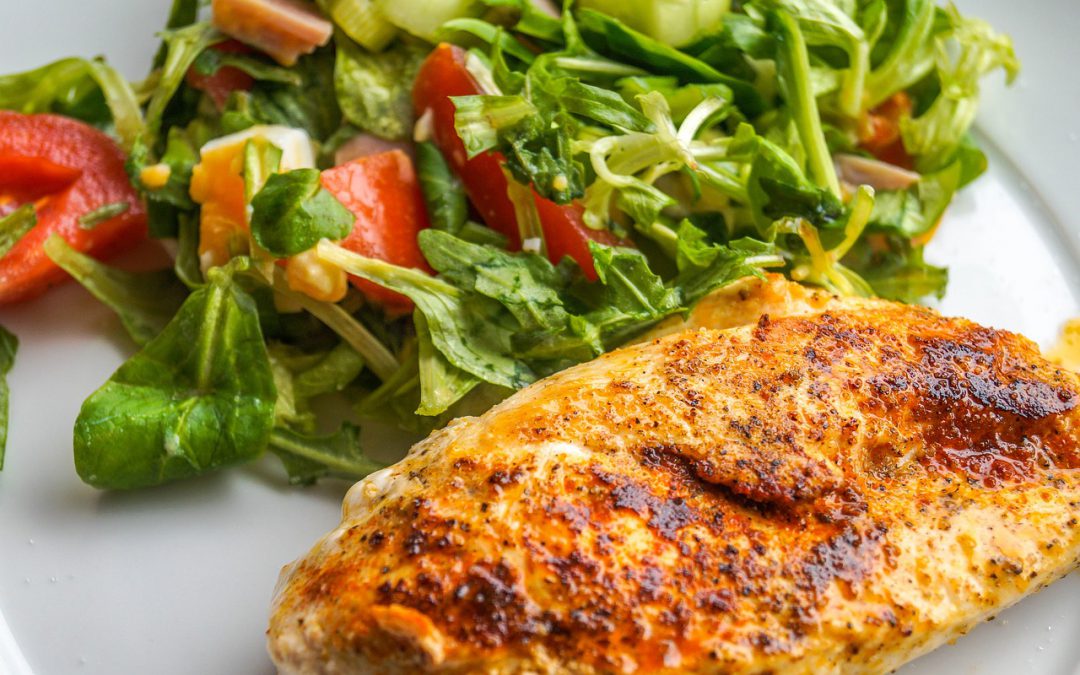
-1 pound of chicken breast (crockpot or grilled)
-Large salad with mixed greens, 100g of tomatoes, 2 persian cucumbers, no calorie or low calorie dressing (Walden Farms or Skinny Girl)
-28g no fat cheddar (might go on the chicken or might go on the salad.
Dinner
-Another salad with a different flavor dressing
-1 cup nonfat yogurt (optional)
-Protein to get up to 200g (london broil, turkey breast, chicken breast, 95% lean ground beef)
That gives me somewhere between 1150-1250 calories and 200g of protein.
I don’t feel deprived at all eating this way for one day, and it’s a ton of food. (Note, this is based on a 145 LBM (175lbs at ~15% BF.
Question from the Peanut Gallery: How did you handle work? Answer: There’s a refrigerator and microwave at work. I keep a bottle of chipotle Tabasco, salsa, and no calorie dressing there.
Day 12, End of Diet Recap
It’s day 12 off the PSMF. I had planned to stay on the diet through the end of today, but I have a free lunch at work, and a party at home tonight, so sacrifices must be made.
Weight: I started at 174, and today I was 167.4. At least 3-5 pounds of that is water and glycogen since a PSMF is ketogenic (glycogen depleting).
Waist: My waist went from 33 to 31.5″. I’m now wearing size 32 pants with extra room in the waist. Before the diet, I couldn’t fit into them comfortably.
Strength: I lost one rep on incline (but sometimes I lose a rep when eating normally), none on OHP, Squat, or Chins.
Feeling: For the most part, I felt great on the diet. I never felt hungry or deprived (except in the sense that I couldn’t eat the catered lunches at work). I forgot to take my magnesium supplement last night, and woke up with a leg cramp at 3am (although I’ve had similar cramps just on AFL). Other than that, I’ve had no negative experiences with the diet.
Conclusion:
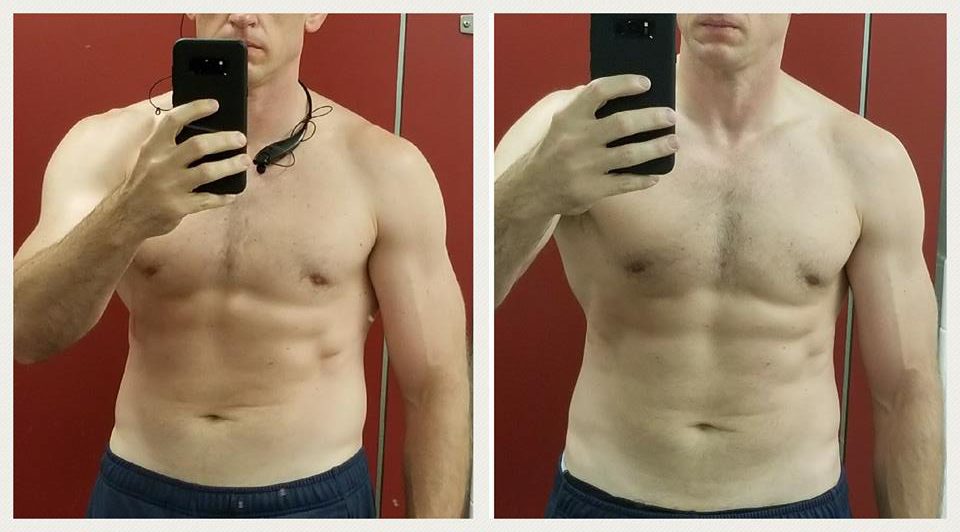
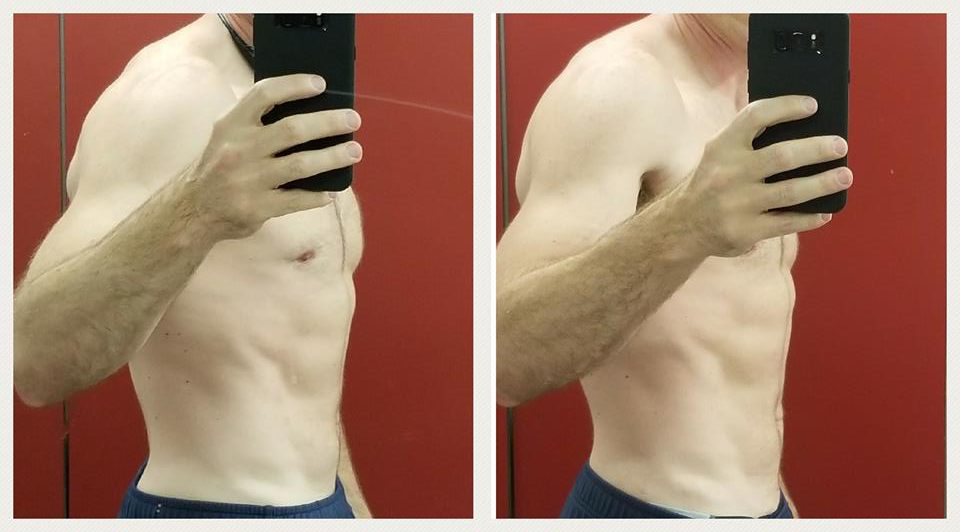
Like I said in my last update, I’m not sure that I’d do this again, but I can certainly see eating like this one or two days a week to occasionally to maintain a deficit. As promised, here are the before and after photos. They’re kind of subtle, but I definitely have a lot more shoulder definition and slightly more ab definition. My wife says I look like an underwear model again.
Okay, okay. It’s more like 8 hours of eating, since I intermittent fast (basically just skip breakfast).
One of the things that helped convince me that I could handle this diet thing was 24 hour eating videos. I didn’t actually video myself eating today, but I ate what seems like an enormous amount and still kept it under 1800 calories. So I’m going to share all of the food that I ate today. If you’re new to this whole tracking your calories thing, try logging the food here in MyFitnessPal to check my work.
I woke up at 7 am and then went back to sleep until 8. Then I took care of the kids. The kids and I started playing computer games until 1pm.
Snack/Breakfast
At 1:30, I had a Diet Cherry Dr Pepper and a banana. It was 121g without the peel. That was enough to stave off my hunger for another hour while I got the kids fed and made lunch for myself.
Lunch
By the time lunch was done, and I sat down to eat, it was 2:30. I had
400g of chicken breast (weighed raw). Slice it lengthwise so you get two thinner pieces. Salt both sides and sprinkle with Ranch powder. Sautee said chicken in 2g of Kerry Gold butter.
I actually planned out dinner before lunch. Corban had asked for Taco Friday a couple days ago, so I already had a pretty good idea of what I was going to eat. Instead of a taco, I made mine into taco salad. Started cooking around 6:45 and finished eating around 7:30.
4 oz organic grass fed ground beef (from Aldis) with taco seasoning and 25g of onion
Finlandia reduced fat cheddar (2 slices)
Tomatoes 100g
5 black olives (sliced)
Friendly Farms Brand Nonfat Greek Yogurt 80g (different brands of Greek yogurt vary wildly in their protein/sugar content; this brand has the most protein and least sugar of all I’ve tried)
Little bit of taco sauce
Kirkland Organic Tortilla Chips 28g
I didn’t track the taco seasoning or the lettuce. This is a great flavorful (albeit relatively small meal). You could use sour cream or low fat sour cream, but I use the Greek Yogurt mostly for its protein content to hit my macros.
Macros for Dinner
Calories 594
Protein 45g
Carbs 29g
Fat 34g
Dessert
After dinner, I went for a walk. After walking, I had dessert (about 8:30). I’m still 10g of protein short, so it’s time to Release the Secret Weapon!!
Halo Top Ice Cream!
This stuff is some kind of magic. One cup of ranges from 120-180 calories (about half the calories of normal ice cream) AND it has relatively high protein (10-14g per cup). AND it tastes really good. Here in South Florida, you can buy it at Target, Walmart, and Publix. Someone I know in Tarpon Springs says his Costco carries it (sadly, mine does not). People also report buying it at Krogers (we don’t have any down here).
I’ve been working my way through the flavors. Tonight was S’mores. I rank it third of the three flavors I’ve tried so far. It has small chocolate chips in it, and they get stuck in my teeth (same reason I don’t like mint chip). So far, my favorite flavor is cookie dough followed by peanut butter cup. Once I’ve tried all the flavors I can get locally, I’ll post my full ranking.
Macros for Dessert
Calories 160
Protein 10g
Carbs 32g
Fat 5g
Halo Top Alternatives
Okay, you don’t actually have to buy specialty ice cream. You could have gotten the same effect from eating 50 more grams of chicken breast and 2 Oreo cookies. Regular ice cream can also be an option, but you only get to have half a cup (usually about 100g) for 130 -160 calories. The nice thing about the specialty ice creams is that you can eat more of it than traditional ice cream, so you feel less deprived. And the extra protein does mean that you can be a bit more flexible with the rest of your day.
So here are a couple other low calorie Ice Creams/Yogurts
Yasso makes several different products. The one I’ve had is a cookie dough frozen yogurt bar. It’s 100 calories and has 5g of protein. Tastes very good. They have them at Walmart and BJs near me.
Englightened produces a low calorie, high protein ice cream and ice cream bar. I haven’t personally eaten them yet, but a friend says he likes them better than Halo Top.
Final notes
My total calorie count for the day is 1771 calories with 159g protein, but I’m probably over estimating my fat intake since I drained the taco meat and overestimate my oil spray. On the other hand, I didn’t log the Ranch powder, taco seasoning, or lettuce.
Although I’m known at work as a mild-mannered pharmacology nerd with mad computer skillz, my first love is “extreme” sports and physical challenges. Recently I engaged in a couple fun physical challenges, flying trapeze and flyboarding. Here are the videos:
Flyboarding
This was my first time flyboarding. It’s really fun, but has a bit of a learning curve. This video is the result of a 25 minute session cut down to two and a half minutes. The key is to somehow lock your ankles and knees but keep your body relaxed. You can see on my better attempts that my ankles/feet stay in the same position. On my less stable attempts, you can see how unstable my ankle angle is. I hear that the second and third time sessions are dramatically easier than the first attempt. It’ll be fun to do this again. This was at SoFlo Flyboarding. Kids have to be 80 lbs minimum. Can’t wait till the kids are little heavier…
Flying Trapeze
This was actually my second time doing the trapeze, but the first time was more than two years ago. This was an Aerial Trapeze Academy Groupon. With the Groupon, you only get to do the beginner session, which is three practice swings, where you try to get into the knee hang/transfer position. If you can successfully get into that position, then on the fourth swing, you get to to try for a mid air catch. They also do birthday parties and private groups. Kids can do it as young as 4 years old, and they work with autistic kids. Once you’ve done the beginner session, you can do more advanced stuff. This is really easy and fun if you have any amount of athleticism/body control. Highly recommended. PSA: Hanging from the bar with your knees can give you friction burns. If you have leggings or tights, you should wear them.






Recent Comments